


Will Your Battery Survive a Toronto Winter? A Cold-Weather Starting Checklist
A battery can seem perfectly healthy in September and still leave you stranded on the first truly cold morning of the season. Toronto’s winter brings freezing temperatures, short trips, heavy electrical loads, and stop-and-go traffic: conditions that expose a weak battery quickly.
That is why mid-September is a smart time to prepare. Before the first hard frost arrives, a battery test can tell you whether your vehicle is ready for winter or whether replacement is the safer choice.
If you have been searching for a mechanic near me, a mechanic in Toronto, or reliable auto repair in Toronto, use this checklist to understand what your battery needs and when professional testing is worthwhile.
Why Toronto cold weather is hard on car batteries
Your battery produces electrical power through a chemical reaction. As the temperature drops, that reaction slows, reducing the amount of energy available to start the engine.
At the same time, cold engine oil becomes thicker. The starter motor must work harder to turn the engine, creating higher demand precisely when the battery has less power to provide. It is a little like trying to run a marathon while breathing through a scarf: the system can still work, but it has less capacity and must work harder.
The first hard frost often reveals a battery that was already weakened by age, repeated short trips, or summer heat. A battery may start the car normally at 15°C but struggle at -15°C, particularly if the vehicle is parked outside overnight.
According to CAA’s guidance on cold cranking amps, cold cranking amps, or CCA, measure a battery’s ability to deliver starting power at low temperatures. Your vehicle’s owner’s manual specifies the correct battery size and minimum CCA. A replacement should meet or exceed those requirements.
Warning signs your battery may not survive winter
Do not wait for a complete no-start. Your vehicle often gives you clues that the battery or charging system needs attention.
1. The engine cranks slowly
A healthy vehicle should turn over promptly when you start it. If the engine sounds sluggish or takes noticeably longer to crank, the battery may be losing starting capacity.
Pay particular attention if the slow crank happens repeatedly or becomes more noticeable on cool mornings.
2. You hear clicking when you start the car
A single click: or a rapid series of clicks: can indicate that the starter is not receiving enough power. A weak battery is one possible cause, although poor connections, a faulty starter, or another electrical problem can create similar symptoms.
If your vehicle only starts after a boost, have the battery and charging system tested rather than assuming the boost solved the problem.
3. Your lights dim
Headlights or interior lights that dim while the engine is idling can point to a weak battery, a charging problem, or a poor electrical connection. If the lights brighten when you raise the engine speed, the alternator may not be providing consistent output at idle.
This symptom should not be ignored. A battery replacement will not correct an alternator or wiring fault.
4. The battery warning light comes on
The battery-shaped warning light usually relates to the charging system, not simply the battery itself. It may indicate an alternator problem, a slipping belt, a wiring issue, or a battery that is no longer accepting a charge properly.
If the light remains on while you drive, arrange an inspection promptly. Continuing to drive with a failing charging system can eventually drain the battery completely.
5. You have needed repeated boosts
One boost may happen because someone left the lights on. Repeated boosts, however, suggest an underlying issue. The battery may be nearing the end of its service life, or the alternator may not be recharging it correctly.
As CBC’s winter battery advice notes, average battery life is commonly around three to five years, although climate, driving habits, vehicle design, and maintenance all affect how long a battery lasts.
Your Toronto pre-winter battery checklist
A few straightforward checks can reduce the chance of a cold-weather breakdown.
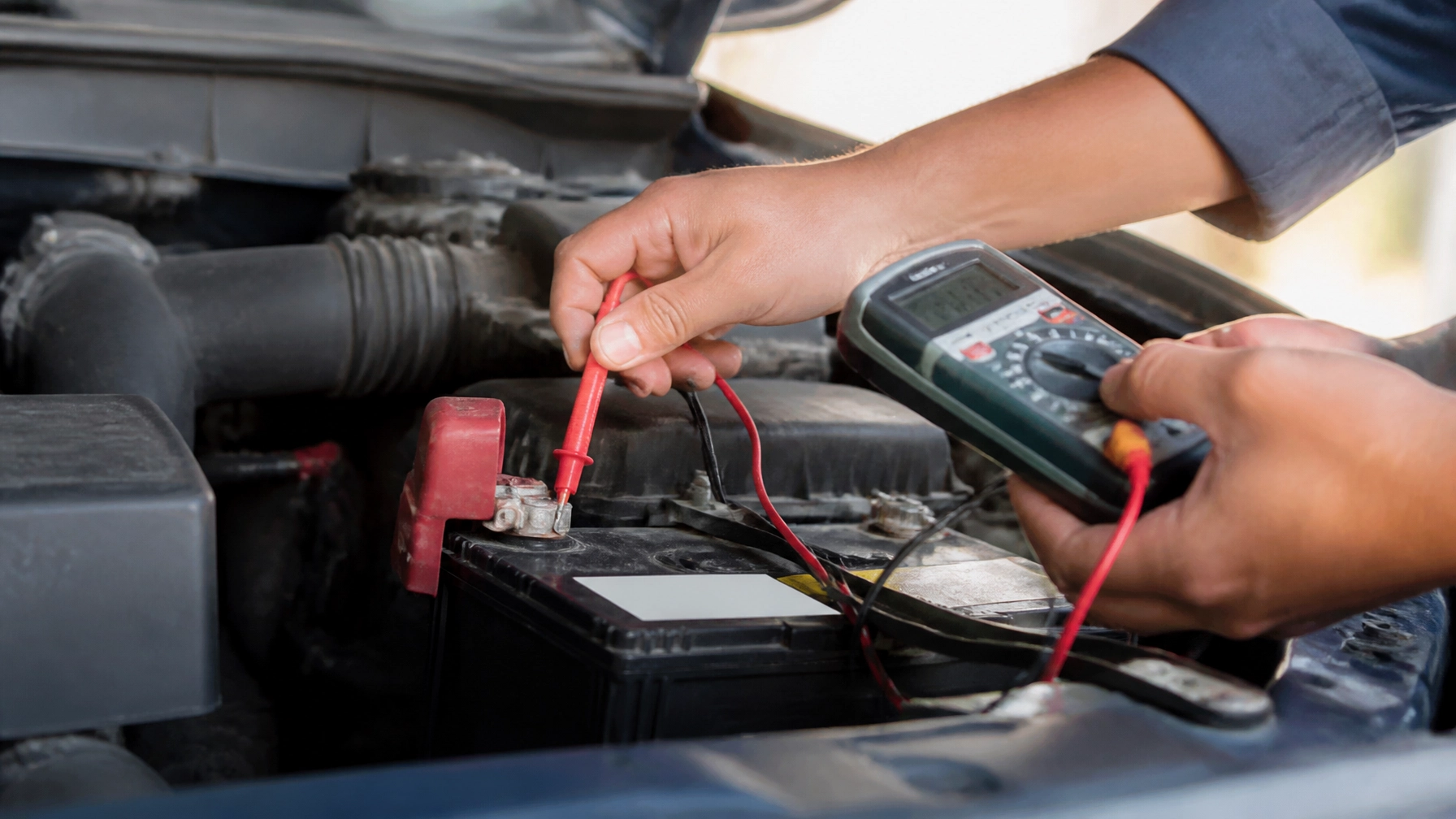
Have the battery load-tested
A basic voltage reading is useful, but it does not tell the whole story. A battery can show acceptable voltage and still fail under the heavy load required to start an engine.
A proper battery test can assess available cranking power, state of charge, and overall condition. Ask for the test result and compare the measured performance with the battery’s rated CCA.
Testing is especially important if:
- Your battery is three years old or more
- You notice slow cranking or clicking
- Your vehicle has needed a boost
- You frequently make short trips
- The car is parked outside
- You plan to travel outside the city during winter
Clean and inspect the terminals
Corrosion around the battery posts and cable connections can restrict current flow. Look for white, blue, or greenish buildup, loose terminals, damaged cables, or swelling around the battery case.
Do not attempt to clean or disconnect a battery if you are unsure of the procedure. Batteries contain corrosive electrolyte and can produce sparks. A technician can inspect the connections safely and confirm that the cables are secure.
Check the alternator and charging system
The alternator recharges the battery while the engine runs and powers the vehicle’s electrical systems. If it is undercharging, the battery may be weakened even if the battery itself is relatively new.
A complete electrical inspection should include the alternator, starter, battery cables, grounds, belt condition, and charging voltage. This is particularly important when the dashboard battery light is on or your lights flicker.
Confirm the correct battery specification
Do not choose a battery based only on price or physical appearance. Your vehicle needs the correct group size, terminal arrangement, reserve capacity, and CCA rating.
Some newer vehicles, especially those with start-stop systems or extensive electronic equipment, require AGM battery technology. Always follow the vehicle manufacturer’s specification. A higher CCA rating can provide additional starting margin, but the battery must still fit the vehicle and match its electrical requirements.
Check your block heater
If your vehicle is equipped with a block heater, inspect the cord before winter. Look for cracked insulation, exposed wires, or a damaged plug. Use an outdoor-rated extension cord if one is required, and follow the vehicle manufacturer’s instructions.
A block heater warms the engine and oil, reducing the effort required to start in very cold weather. It does not recharge a weak battery, so it should be treated as a helpful cold-weather tool: not a substitute for battery testing.
Prepare an emergency kit
Keep practical winter supplies in your vehicle, including:
- Booster cables or a charged jump starter
- Ice scraper and snow brush
- Extra gloves, hat, and warm clothing
- Blanket
- Flashlight
- Phone charger or power bank
- Bottled water and non-perishable snacks
- Windshield washer fluid rated for winter temperatures
If your vehicle does not start, avoid repeated long cranking attempts. Turn off the heater, radio, lights, and other accessories before trying again, and arrange assistance if the battery continues to click or crank slowly.

Should you replace the battery or maintain it?
The answer depends on the test results, age, symptoms, and condition of the rest of the charging system.
Replacement is usually the better choice when:
- The battery fails a load or CCA test
- It has a cracked, leaking, or swollen case
- The measured starting capacity is significantly below its rating
- The vehicle needs repeated boosts
- The battery is older and already showing cold-start symptoms
- The charging system is healthy but the battery cannot hold a charge
Replacing a battery before it fails completely is often less stressful and less expensive than dealing with a no-start in a snowy parking lot or on a cold Toronto morning.
Maintenance may be appropriate when:
- The battery passes its load test
- Terminals are clean and secure
- The charging system is operating properly
- The battery is within its expected service life
- There are no starting or lighting symptoms
Maintenance does not mean ignoring the battery until spring. Continue watching for slow cranking, warning lights, dimming lights, or changes in starting performance throughout the season.
Get your battery ready before the first hard frost
At Cochrane Automotive, we have been serving Toronto drivers since 1972. Our government-licensed technicians use cutting-edge diagnostic technology to test batteries, alternators, starters, and other electrical components across all makes and models.
As a CAA Approved Automotive Repair Service Centre, we are committed to dependable repairs and clear communication. We provide dealership-level expertise as a dealership alternative with better prices, plus a 3-year/60,000 km warranty on parts and labour. Courtesy vehicles and shuttle service can help keep your day moving while your vehicle is being inspected.
Do not wait for the first deep freeze to find out whether your battery is ready. Book a battery test with Cochrane Automotive before winter arrives and start the season with greater confidence, dependable starting power, and one less thing to worry about on Toronto’s roads.
Related Posts

How to Find an Honest Mechanic Near You in Toronto (Without Getting Ripped Off)
Searching for a mechanic near me can feel stressful, especially when you’re worried about paying for repairs you don’t understand: or being pressured into work your vehicle may not need. The good news is that finding an honest auto repair…

Is Your Car Ready for an EV Future? How We Service Hybrids and Electric Vehicles at Cochrane
Toronto’s roads are changing. You may already see more battery-electric vehicles, plug-in hybrids, and conventional hybrids on the Gardiner, around Etobicoke, and throughout the GTA. As charging infrastructure expands and more drivers consider making the switch, one question comes up…
How to Choose the Right Tires for Toronto’s Pothole-Packed Roads (Without Overpaying)
Toronto roads can be hard on a vehicle. After a winter of freezing and thawing, familiar routes can fill with sharp-edged potholes, broken pavement, and uneven repairs. Even careful drivers can end up with a bent wheel, a sidewall bulge,…